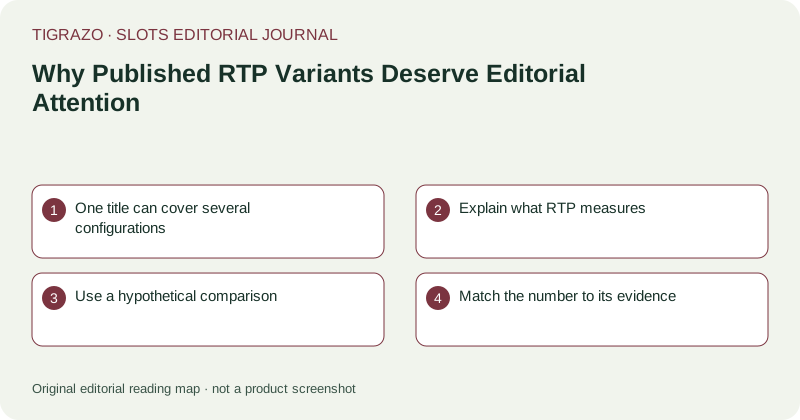
One title can cover several configurations
Shared names and artwork do not establish one mathematical setting across every context. Documentation may list several RTP variants, or a loaded game may display a percentage different from a general release summary. The editorial issue is specificity. A statement about one configuration can be accurate while becoming misleading when applied to every instance of the same title without qualification.
Explain what RTP measures
RTP is expected gross return relative to wager volume over a long run under defined rules. It is not a promise about an individual's deposit or session. A variant changes the applicable expected-return figure, but it does not establish a particular sequence of outcomes. Coverage should repeat this distinction where a comparison might otherwise encourage readers to interpret a higher percentage as a near-term recovery mechanism.
Use a hypothetical comparison
Consider hypothetical configurations with RTPs of 94 and 96 percent. Over one thousand units of wager volume, their expected losses are sixty and forty units respectively, assuming the percentages cover the same components. The twenty-unit difference is a difference in expectation for that volume. It is not a guaranteed saving in any session, and it does not imply that the configurations have identical volatility or award frequency.
Match the number to its evidence
An editor should record where the percentage appears, which build or context it identifies and whether it covers optional components. If several variants are published, report that fact rather than selecting the largest number for a headline. If the currently applicable variant cannot be established, say so narrowly. Avoid implying that the existence of multiple configurations proves misconduct or that every discrepancy is a simple mistake.
Make the qualification visible
- Name the relevant configuration where known.
- Keep the percentage attached to its scope.
- Distinguish published options from confirmed deployment.
- Use consistent wager-volume examples.
- Do not infer volatility or feature frequency from RTP alone.
A qualification buried far from the headline may not prevent misunderstanding. Summaries, cards and comparison tables should preserve the same scope as the main article. Otherwise a careful body text can still be undermined by an overbroad display label.
Attention to variants is ultimately an accuracy practice. It replaces a memorable but potentially incorrect title-level number with a properly bounded statement. That gives readers a better understanding of the information without turning the article into a recommendation or a prediction about personal results.
Tables need explicit column labels when comparing variants. A percentage without its configuration name or availability context can lose the qualification supplied elsewhere. Consistency across the publication matters because readers may encounter the table independently of the explanatory paragraphs surrounding it.