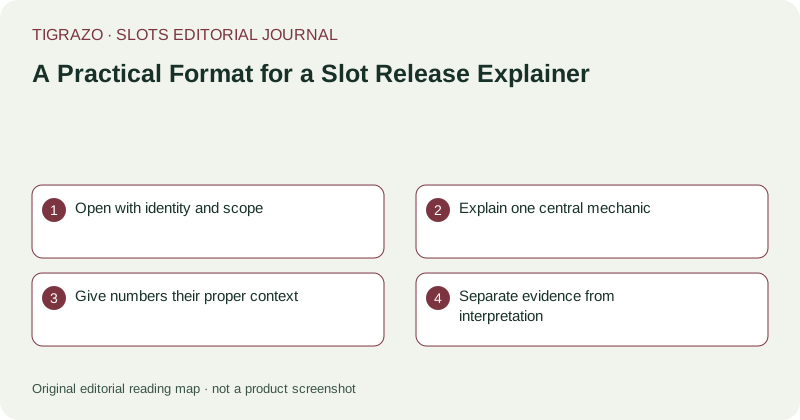
Open with identity and scope
The introduction should name the subject and describe the event being reported, such as an announced release, an update or a new listing. These are not interchangeable. Include a date only when its meaning is clear. If coverage concerns a publisher's announcement rather than confirmed availability everywhere, preserve that distinction. A precise opening prevents the rest of the article from inheriting an exaggerated launch claim.
Explain one central mechanic
Choose the feature most relevant to understanding the announcement and describe its conditions in ordinary language. Define unfamiliar terms before adding detail. For example, explain what persists and when it resets rather than merely repeating a sticky-feature label. The goal is comprehension, not a complete catalogue of adjectives. If the supplied material lacks a trigger or duration, identify the missing condition.
Give numbers their proper context
Any multiplier needs a stake basis, any RTP needs a relevant configuration, and any jackpot amount needs its type and timing. A hypothetical maximum of two thousand times total stake can be translated into four thousand units at a two-unit stake, but that calculation says nothing about probability. Label examples as hypothetical and keep them distinct from actual release specifications. Do not import figures from similarly named games.
Separate evidence from interpretation
A compact explainer can use clearly distinguished passages for documented mechanics, attributed promotional claims and editorial context. A publisher's assertion that a design is unique belongs in the second category unless broader evidence supports it. General context can explain that similar feature names sometimes cover different rules, but it should not invent a competitive comparison or a historical first.
End with useful open questions
- Which versions or locations are covered?
- Are complete rules available?
- Which configuration does a supplied percentage describe?
- Are feature limits and reset conditions clear?
- What cannot be evaluated from announcement material?
The ending need not recommend play or assign a rating. It can summarise what the announcement establishes and what further documentation would be needed for a different kind of article.
This structure also makes updates easier. If a missing rule later becomes available, the editor can revise the relevant section without rewriting a broad verdict. Readers gain an explainable information trail: identity first, mechanics second, numerical context third, and uncertainty stated plainly. Consistency of method is more valuable than forcing every release into the language of a review.
An explainer should also define its update policy. Later documentation may resolve an unknown without proving that the original report was wrong. Distinguishing an added detail from a correction helps readers follow how the account developed and why its conclusions remain appropriately limited.