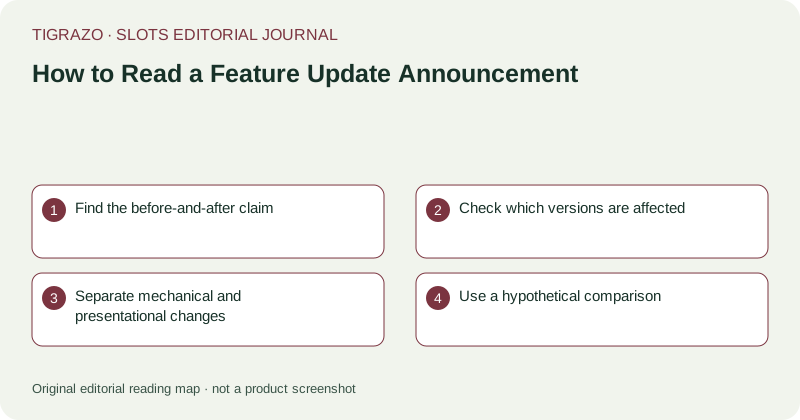
Find the before-and-after claim
A useful update story identifies the previous behaviour and the revised behaviour in comparable terms. Without that baseline, phrases such as enhanced feature provide little information. The change might concern an animation, a trigger condition, an information panel or an award calculation. Those are distinct developments. Coverage should name the dimension rather than treating every update as a broad improvement to the game.
Check which versions are affected
An announcement may describe one build, region or distribution context. It does not automatically establish that every instance of a title has changed. Look for version identifiers, rollout scope and effective dates where supplied. If those details are absent, report the announcement's limited scope. Do not turn an unspecified update into a claim that a reader's currently loaded game already uses the revised rules.
Separate mechanical and presentational changes
A faster animation is not necessarily a different outcome model. A rewritten help panel may clarify an existing rule rather than alter it. Conversely, a change to a trigger threshold or multiplier reset can be mechanically significant even if the screen looks familiar. Compare actual rule language where available. Visual difference and mathematical difference should never be treated as equivalent measures of update size.
Use a hypothetical comparison
Suppose an announcement says a multiplier now persists through an entire feature rather than one evaluation. A useful explainer would define both reset boundaries, identify the affected feature and check whether other award rules also changed. It would not independently infer a new RTP or promise larger session returns. A mechanical change can affect the distribution of outcomes, but its full mathematical effect needs supporting information.
Report the unresolved questions
- What exact behaviour changed?
- Which builds and contexts receive it?
- When does the revised rule apply?
- Does the supplied documentation distinguish clarification from alteration?
- Which numerical effects remain unpublished?
These questions help editors avoid false certainty while still explaining the update clearly. An unresolved field is not proof of a problem; it is a boundary on what the story can responsibly conclude.
Calling an update better requires criteria. Better readability, clearer help text and a changed award structure are different claims with different evidence. A measured article describes each supported change separately and leaves the overall verdict open when the available information cannot support one. That is especially important when promotional language invites readers to equate novelty with financial advantage.
Rollout language also deserves scrutiny. Available now may refer to an announced distribution stage rather than universal visibility. Where coverage cannot establish deployment, describe the stated rollout instead of directing readers to expect an identical interface or feature in every existing instance.