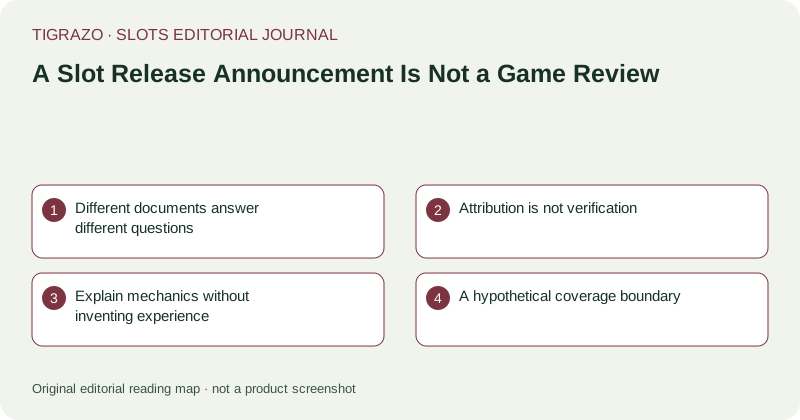
Different documents answer different questions
An announcement can establish what has been announced, how the publisher describes it and which details have been supplied. A review asks additional questions about rules, usability, information quality and the limits of its observations. Confusing those purposes makes promotional claims appear independently confirmed. Editorial coverage should identify the source and distinguish what the announcement says from what the writer has actually established.
Attribution is not verification
A statement that a publisher describes a feature as innovative accurately reports a claim, but it does not establish innovation. That broader conclusion would require a definition and a comparison with relevant earlier designs. The same applies to words such as accessible, unique and popular. Retaining attribution helps, but repeating a claim prominently can still imply endorsement unless its evidentiary status remains clear.
Explain mechanics without inventing experience
A release explainer can translate documented feature conditions into plain language. It can describe an ordinary award method, a trigger or a rule change. It should not invent observations about responsiveness, session feel or award frequency. A writer who has only announcement material cannot honestly describe personal testing. Even genuine short observations would not establish long-run RTP or reliable probabilities for rare outcomes.
A hypothetical coverage boundary
Imagine an announcement naming a new expanding-symbol feature and providing its trigger rule. A careful explainer could state the trigger, describe the expansion and identify missing duration details. It could not conclude that the feature appears often, that the game is technically stable on every device, or that it offers better value than alternatives. Those conclusions require different evidence from the supplied release description.
Label the article honestly
- Use announcement or release explainer when that is the format.
- Separate attributed claims from documented rules.
- Identify missing information without filling it with praise.
- Avoid ratings unsupported by an evaluation method.
- Keep visual description separate from mathematical conclusions.
This approach does not make coverage less useful. It gives readers a clear account of what changed and what remains unknown. A concise explanation of a mechanic can be more informative than a broad verdict that merely echoes promotional adjectives.
A release announcement is a legitimate editorial starting point. It becomes misleading only when its purpose and evidence are disguised. The appropriate result may be an informative report with no recommendation, no score and no claim about how an individual player's future session will unfold.
Headline verbs matter as well. Announces, describes and introduces preserve the relationship to release material more accurately than proves or delivers when no evaluation supports the stronger wording. The title should maintain the same evidence boundary as the article beneath it.