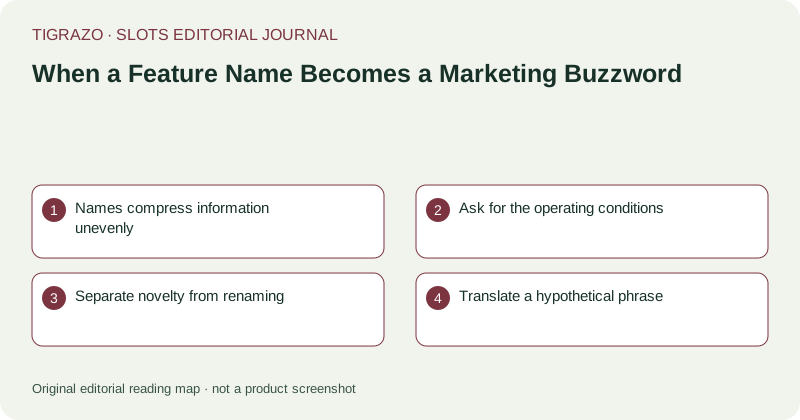
Names compress information unevenly
Some feature labels describe a recognisable action, such as a symbol expanding or persisting. Others are branded phrases with no stable meaning outside one game. Even familiar terms can cover different triggers and durations. A name is therefore an index to a rule, not the rule itself. Repeating it without explanation can give readers the impression of understanding while leaving the essential mechanics unstated.
Ask for the operating conditions
A precise description identifies the trigger, the action, the duration and the reset boundary. If a feature changes a multiplier, it should also establish which awards receive that multiplier and how multiple values combine. These questions work across many labels. They replace vague claims of enhanced action with a specification that readers can actually compare with another documented mechanic.
Separate novelty from renaming
A distinctive name does not prove a distinctive mathematical process. Conversely, a familiar label can describe a materially different implementation. Establishing novelty requires comparison and an explicit definition of what is new. Without that evidence, an editor can report that a feature has been introduced under a particular name while withholding the broader claim that the underlying idea is unprecedented.
Translate a hypothetical phrase
Imagine an announcement calling a mechanic momentum expansion. That phrase alone says little. If the accompanying rules explain that each qualifying cascade adds one active row until the paid round ends, the article can state that process directly. It should not infer that the expansion continues across ordinary spins, guarantees an award or increases RTP. The translation should preserve every documented boundary and add none of its own.
Use a plain-language replacement test
- Can the feature be explained without its promotional name?
- Are trigger and duration both known?
- Does the description separate presentation from award rules?
- Are probability claims supported independently?
- Would another editor interpret the wording the same way?
If the explanation collapses when the brand phrase is removed, the available information may be too thin for a mechanical claim. The article can still report the announcement, but it should identify the missing details rather than fill the gap with enthusiasm.
Marketing names are not inherently unhelpful. They can make complex material memorable once the underlying rules are understood. The editorial problem arises when the name replaces explanation or carries unsupported implications about value, frequency or originality. Clear translation lets readers recognise the label without being asked to accept its promotional conclusion.
A glossary can support consistency across stories, provided it records mechanical definitions rather than promotional slogans. Where a term changes meaning between games, the article should retain the local definition. A familiar label should never erase a documented difference in operation or reset conditions.