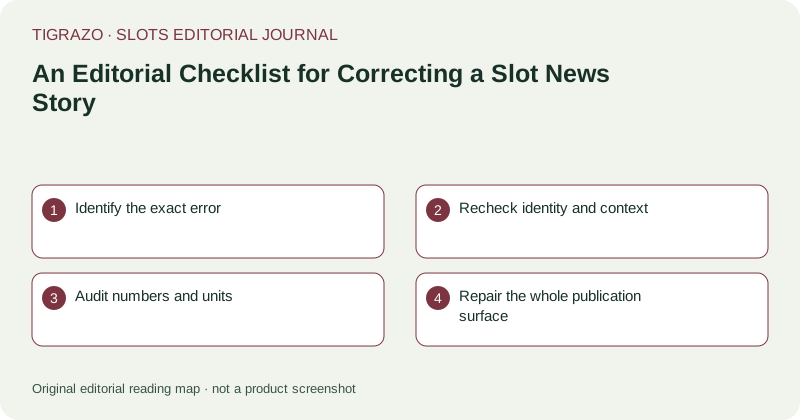
Identify the exact error
Start with the published sentence, headline, table cell or card field. State what it claimed and why that claim is inaccurate or insufficiently supported. Broad phrases such as updated for clarity can conceal a substantive correction. Distinguish a factual error from a changed circumstance, a newly available detail or an editorial interpretation that needs stronger qualification. Each calls for a different explanation.
Recheck identity and context
Confirm the title, edition, version and relevant date before replacing a figure. A percentage from another configuration is not a valid correction merely because it appears in newer material. Likewise, a catalogue addition date cannot replace an original release date without changing the field's meaning. The correction process should resolve the original mismatch rather than introduce a second one under a more recent timestamp.
Audit numbers and units
Check whether amounts are gross awards or net results, whether multipliers use total stake or line stake, and whether percentages describe RTP or relative growth. In a hypothetical correction, a story that called a rise from twenty to twenty-five percent a five-percent increase should say five percentage points, or a twenty-five-percent relative increase. The corrected wording must preserve the intended metric and make its basis explicit.
Repair the whole publication surface
An accurate paragraph does not fix a misleading headline or summary card. Review captions, tables and introductory descriptions for the same error. Remove any interpretation that depended on the incorrect claim, such as a supposed comparison advantage based on a mismatched RTP. A correction should not leave the original implication intact while changing only the smallest visible number.
Explain the amendment proportionately
- State what was wrong.
- Give the corrected fact with its scope.
- Identify whether related conclusions changed.
- Record the amendment date where appropriate.
- Preserve unresolved questions rather than inventing certainty.
A hypothetical note could explain that an earlier version described a listing date as an original release date, and that the article now distinguishes the two. That is more useful than a vague claim that timing information has been refreshed. No invented source or quotation is needed to make the correction sound authoritative.
Finally, check the article's format label. If it relied only on announcement material, changing a review label to release explainer may be necessary alongside factual repairs. A good correction restores the relationship between claim and evidence. It does not need to defend the original wording or replace it with an equally unsupported verdict.
Corrections can also expose a workflow problem. If the error came from dropping a stake unit during summarisation, review how numerical fields are copied into headlines and tables. The useful lesson is a targeted editorial check, not an unsupported promise that mistakes cannot recur.