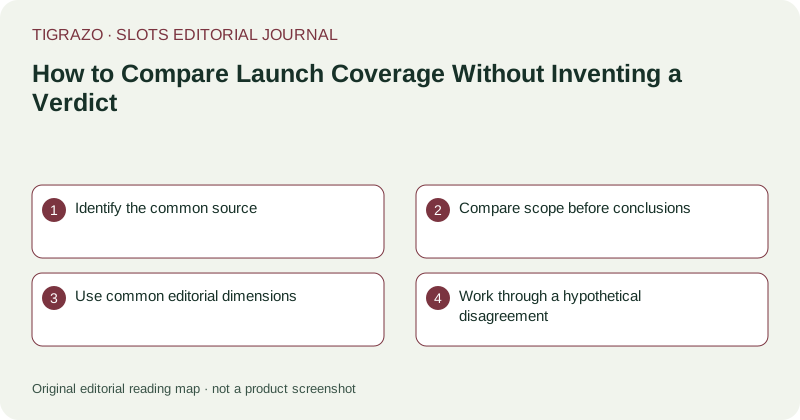
Identify the common source
Look for matching phrases, identical figures and the same sequence of feature descriptions. These can indicate reliance on shared announcement material. That does not make the reporting worthless, but it limits independence. Three articles repeating one supplied RTP figure are not three separate confirmations of the applicable configuration. The comparison should distinguish source repetition from genuinely additional documentation or evaluation.
Compare scope before conclusions
One article may be a short announcement, another a rules explainer and another a review with a stated method. They should not be assessed as though they promised the same work. A short news item can be accurate and useful within its scope. A longer piece can still overstate its evidence. Length, confident language and elaborate formatting do not independently establish stronger reporting.
Use common editorial dimensions
| Dimension | Question |
|---|---|
| Identity | Is the release or version clearly identified? |
| Evidence | What supports each material claim? |
| Mechanics | Are conditions explained accurately? |
| Limits | Are uncertainties made visible? |
These dimensions evaluate the coverage, not the game's financial prospects. They can reveal that an article explains a trigger well while omitting configuration context, without forcing a single numerical score.
Work through a hypothetical disagreement
Suppose one article calls a feature new and another calls it familiar. The disagreement may concern branding, implementation or the wider concept. Before choosing a side, ask how each defines new and what comparison it supplies. If neither offers a baseline, the defensible conclusion is that novelty remains unestablished. It is not necessary to invent a verdict merely because the two headlines sound incompatible.
Write a bounded synthesis
A useful synthesis identifies shared verified details, unique supported contributions and unresolved conflicts. It can say that multiple pieces rely on the same announcement and that one supplies a clearer explanation of a reset rule. It should not conclude that repeated praise proves popularity, technical quality or favourable returns. Those require different evidence from the coverage itself.
- Trace claims to their sources.
- Respect each article's stated format.
- Compare specific editorial dimensions.
- Separate disagreement from missing definitions.
- Leave unsupported conclusions open.
The result is a map of information quality rather than a disguised game ranking. Readers learn which questions have been answered, which claims are repeated and where further documentation would genuinely improve understanding.
Comparison notes should also preserve publication timing. An early report may reasonably lack a detail released later. That is different from ignoring information already available at publication. Chronology helps distinguish an incomplete first account from an unsupported claim presented as a settled fact.